Compare specialist cleaning quotes by matching the exact items, components
and areas included, then checking access, surface condition and exclusions.
Ask for the total payable, including applicable VAT and any mandatory
charges, and clarify what remains subject to assessment. Two prices are
only meaningfully comparable when they cover the same work and the same
assumptions.
A short description such as “oven clean” or “gutter clearance” can leave
important details unanswered. For
appliance and gutter cleaning,
the useful comparison is the written scope: what will be cleaned, what
can be reached, what is excluded and how any proposed change will be agreed.
Put the quotes against one shared scope
Write a short list of the work you want and compare each offer against
it. Keep “included”, “excluded” and “not yet confirmed” separate. A
missing item is a question to resolve, not evidence that it is included
for free or that the provider has deliberately left it out.
For example, one offer might describe a single oven cavity and racks,
while another includes the hob as well. These are different scopes.
Ask both providers to confirm a price for the same requested work before
judging the difference. This is an illustrative comparison, not a
statement about any provider's package.
Swipe horizontally to read all columns.
Questions that make cleaning quotes easier to compare
| Check |
Ask each provider |
What to record |
| Items and components |
Which appliances, surfaces, racks, trays or gutter sections
are covered?
|
A specific list, including quantities or locations. |
| Access |
What access arrangements and equipment does this price assume?
|
Restrictions, unresolved checks and any separately priced
arrangements.
|
| Condition and method |
What build-up, materials and existing damage have been allowed for?
|
Known limitations and anything requiring inspection. |
| Price basis |
Is this a fixed price for the stated scope, an estimate or a
time-based charge?
|
The total or calculation basis, applicable VAT and mandatory charges.
|
| Exclusions |
Are repairs, waste removal or further visits included? |
Each inclusion, exclusion and optional extra in writing. |
| Changes |
How will additional work be priced and approved? |
Who can approve it and how the revised scope will be recorded.
|
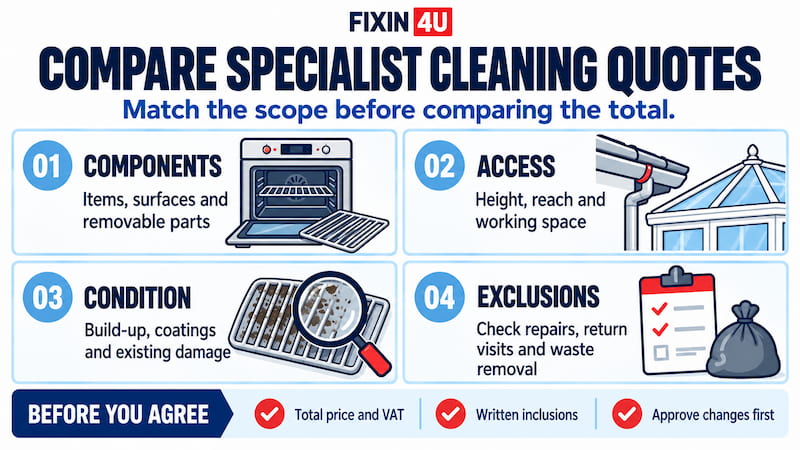 Use the same checklist for every offer. An unspecified item needs
clarification before you compare the totals.
Check exactly which components are included
For
single, double and range oven cleaning,
check the number of oven cavities and whether accessible door glass,
racks and trays are listed. Ask separately about the hob and surrounding
surfaces. Do not assume “range cooker” describes every component to be
cleaned.
For a BBQ, identify the cooking grates, trays and other requested
surfaces. For a pizza oven, distinguish the cooking surface, lining and
exterior. Ask what can be cleaned on that particular model and which
components are excluded. A general description of “removable parts”
does not explain whether a particular part can safely be removed or
is included in the quoted work.
A quote should also make the intended result understandable. Removing
accessible deposits is a different promise from making every surface
look new. Ask about marks or damaged finishes that may remain, rather
than assuming a higher price guarantees complete restoration.
Check the access and condition assumptions
A price based on straightforward access may not describe a restricted
site. For
gutter clearing and debris removal,
match the quoted elevations and sections. Ask how the provider has
allowed for storey height, conservatories, extensions, narrow passages
and the space below the gutter.
HSE's guidance says work at height should be properly planned, with
risks assessed and suitable equipment selected. That makes access an
assessment issue, not simply a reason to accept the cheapest offer.
Ask what remains to be checked; do not climb to provide measurements
or assume a particular access method is suitable.
See HSE's work-at-height guidance.
For appliances, compare the condition information each provider has
used: the extent of residue, known coatings, existing damage and any
restrictions in the manufacturer's care instructions. Ask whether the
proposed price assumes a condition that still needs confirming. A
photo-based assessment should identify its uncertainties rather than
imply that every hidden surface has been inspected.
Compare the total payable and the pricing basis
Ask whether the figure is a fixed price for the defined scope, an
estimate pending inspection or a time-based charge. For time-based
work, clarify the rate, any minimum charge and how further time would
be authorised. For an estimate, ask which assumptions could change and
what information is needed to firm up the price.
Check whether applicable VAT, attendance, travel, parking, access
equipment and removal of collected debris are already accounted for,
excluded or conditional. Not every job involves these charges. The
purpose is to identify the actual payable amount and unresolved items,
not to assume that every provider adds them.
The Competition and Markets Authority's price-transparency guidance
addresses mandatory fees, taxes and charges, including prices added
during a transaction and component prices shown without a clear overall
total. Use that principle when asking for a clear written price.
Read the CMA's price-transparency guidance.
Keep optional extras separate from your requested work. If one offer
includes an additional appliance or service, ask for a comparable
version of the scope rather than treating the larger package as
automatically better value.
Clarify exclusions, further visits and changes
Check whether the proposal covers cleaning only or includes any
separately defined maintenance. Appliance cleaning should not be
assumed to include fault diagnosis, replacement components, gas or
electrical work, or disconnection. Gutter clearing should not be
assumed to include repairs, full replacement or roof work.
If a quote mentions a return visit, ask why it may be needed, what it
would cover and whether its price is included. Distinguish a planned
second stage from a possible additional visit. Also clarify what
happens if access is unsuitable or a defect prevents the agreed work
from going ahead.
Agree who can authorise a change and ask for the added scope and price
before giving approval. For a managed property, identify the
decision-maker in advance. Keep the original quote and any agreed
revisions together so the final record shows what was authorised.
If you are still deciding whether the underlying task is cleaning or
repair, use the separate guide to
choosing a cleaning or repair enquiry.
Settle that distinction before comparing prices for different kinds
of work.
Before accepting, resolve the unanswered items
-
Does the written scope name every item or section you want covered?
-
Have access, condition and method limitations been explained?
- Is the total payable clear, with optional extras separated?
- Are exclusions, further visits and change approval recorded?
Once these points match, compare the price alongside the suitability
of the proposed work. A clear, narrower offer may be enough for your
needs; a broader offer is useful only if you want and understand the
additional work.
References & Standards
Official guidance supporting the points on price transparency and
access planning.
For a Fixin4u cleaning enquiry in London, describe the appliances or
gutter sections, their condition and the access available. Ask for the
proposed inclusions, exclusions and price basis so you can assess the
work being offered.
Discuss your cleaning requirements