Specialist Cleaning or Repair: Which Enquiry Should You Make?
Choose a specialist cleaning enquiry when the main issue is grease,
food residue or loose debris on otherwise serviceable surfaces.
Ask about repair assessment when something is broken, loose, leaking
or failing to operate normally. If both are present, describe both:
cleaning may be part of the work, but it does not replace fault diagnosis
or component repair.
The useful starting point is what you have noticed, rather than the
service name you think you need. “The oven glass is covered in residue”
describes a cleaning task. “The oven no longer heats” describes an
operating problem. A dirty appliance can have a separate fault, and
a gutter containing leaves can also have a damaged joint.
Is the problem a deposit, a blockage or a defect?
Cleaning deals with material that needs removing from a suitable
surface or accessible channel. Repair deals with the condition,
attachment or operation of the item. The distinction matters because
a cleaning method cannot be assumed to restore a cracked part,
secure a loose fitting or correct an appliance fault.
Visible symptoms are a starting point, not a diagnosis. Water
overflowing a gutter, for example, does not by itself tell you
whether the cause is debris, a defect or something else that
needs assessment.
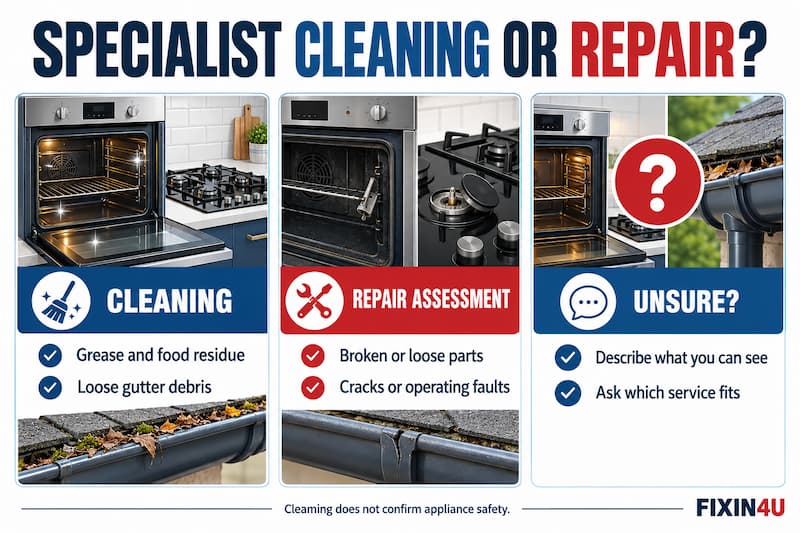 Choose the enquiry from the condition and symptoms.
Cleaning does not confirm appliance safety.
-->
Appliances: distinguish residue from operating problems
Ovens and hobs
Baked-on food, greasy racks and residue on accessible oven glass
are reasons to enquire about
single, double and range oven cleaning.
Grease on a hob or the surrounding area is a different cleaning
task, so identify which surfaces need attention.
If the appliance does not heat, has a damaged control or has a door
that does not close correctly, include that information at the
start. Do not book a clean on the assumption that it will resolve
the fault. Suitable appliance assessment may need to happen first,
and the required repair may fall outside the cleaning provider’s scope.
BBQs and pizza ovens
Food deposits and grease may justify a cleaning enquiry, but the
appliance design and surface materials matter. Ask whether the
proposed method is suitable for the model and its condition.
Do not assume that a method used on a metal cooking grate is
appropriate for a pizza stone, coated surface or oven lining.
Broken fittings, ignition problems and damaged components should
be described separately. BBQ cleaning is not assembly, technical
servicing or a gas-safety inspection. Pizza-oven cleaning should
not be taken to include chimney or flue work.
Gutters: clearing debris and repairing defects are separate
Where leaves and loose debris are the main concern,
gutter clearing and debris removal
is the relevant starting enquiry. Describe where the build-up is
visible and the access around that part of the property.
Access suitability needs checking before work is agreed.
A loose connection, damaged bracket or local leaking section may
instead need
minor gutter repairs and maintenance.
If debris and a possible defect are both present, mention both
rather than assuming either service includes the other.
If water still escapes after a previous clearance, report that
history. It helps distinguish a repeat clearing request from an
unresolved problem requiring further assessment. Minor gutter work
should not be treated as a booking for full gutter replacement,
major roofline repairs or unrestricted high-level access.
What if you cannot tell which service is needed?
You do not need to diagnose the cause before making contact.
Describe the visible condition, what happens during normal use
and whether anything has changed. “There are leaves in the gutter
and water comes from one joint” is more useful than choosing
either “cleaning” or “repair” without that context.
A photograph can help explain the enquiry, but it cannot establish
every hidden defect or confirm appliance safety. Ask whether the
information supports a cleaning booking or whether an assessment
is needed before the work can be defined.
Make the enquiry about the problem and the intended result
Keep the initial description focused: identify the item, explain
the dirt or debris, and mention any damage or operating problem.
For an appliance, include the model if available. For guttering,
explain the affected location and any access limitations you know about.
Be clear about the result you are seeking. Removing visible grease,
clearing accumulated leaves and correcting a leaking joint are
different outcomes. Ask which outcome the proposed work covers,
whether another assessment is needed, and what happens if a separate
defect is found.
Fixin4u’s
specialist cleaning services
provide routes for supported appliance cleaning, gutter clearing
and minor gutter maintenance. The appropriate task depends on
the item, condition, materials and access; an appliance repair
service should not be inferred from a cleaning listing.
References & Guidance
HSE’s guidance on the safe use of cleaning substances supports
the advice in this article about handling cleaning products.
It is workplace guidance, not an appliance repair manual.
Read the HSE Cleaning Guidance