A new bookcase can lean or have uneven doors because the floor support
is uneven, the frame was assembled out of square, a back panel or joint
is incorrectly fitted, or the hinges need adjustment. Damaged panels
and fixing points are another possibility. Door gaps alone do not
identify the cause, and anchoring a unit to the wall does not repair
faulty construction.
If the unit is unstable, visibly damaged or appears liable to tip,
stop using it and keep people away. Do not rock it to test stability,
pull it forward or open doors repeatedly to demonstrate the problem.
Arrange assessment before further adjustment or loading.
What does the visible pattern suggest?
Observe from a safe position without moving the furniture. Note
whether the whole cabinet appears tilted, whether gaps vary around
several openings, or whether one door alone sits low. These are
useful clues for an assembler, not a reliable diagnosis from a photograph.
Swipe horizontally to read all columns.
Possible causes to investigate
| Visible clue |
Possible explanation |
What it does not prove |
| Whole unit leans |
Uneven support, base problem or distorted frame |
That hinges are the main cause. |
| Several gaps taper |
Frame out of square or twisted |
That every door needs separate adjustment. |
| One door sits low |
Hinge setting, mounting position or damaged fixing |
That tightening a screw will solve it. |
| Back edge separates |
Incorrectly seated or secured back panel |
That adding random nails is appropriate. |
| Cracks around fittings |
Damaged panel or failed connection |
That wall restraint will restore strength. |
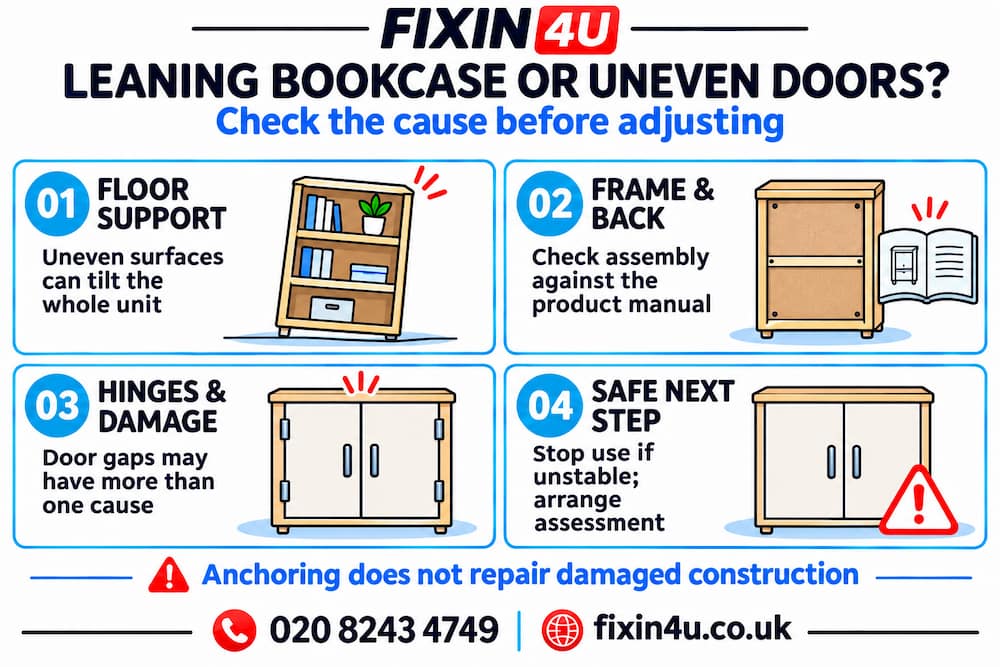 Identify the cause before making adjustments.
Start with the floor and base support
A bookcase partly resting on a rug can sit differently from one
fully supported on the same surface. Sloping boards, uneven flooring
or incorrectly fitted feet can also affect its position. A cabinet
may therefore look tilted even when its individual panels appear
correctly joined.
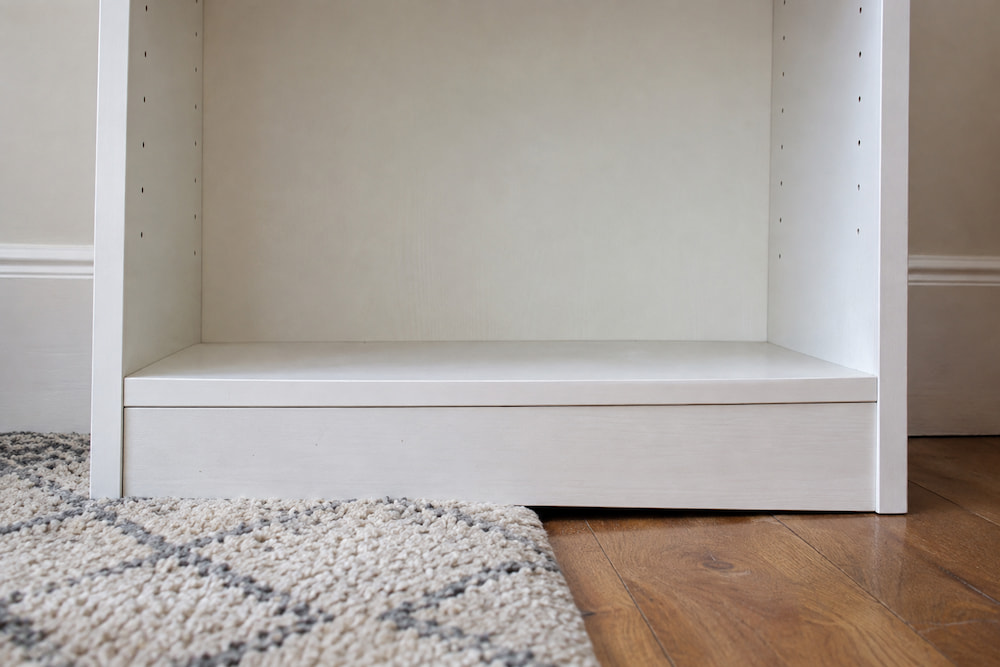 Different surfaces beneath the base can affect how the unit sits.
Record the floor type and whether the problem began immediately
after assembly or after the furniture was moved. Do not crawl beneath
an unstable unit or improvise a stack of packing pieces. Any levelling
method must suit the product and provide the support its instructions require.
A skirting board can also prevent a unit sitting close to the wall.
The resulting gap is not, by itself, evidence of a lean. Do not force
the cabinet against the wall or tighten restraints to pull a distorted
frame into position.
Check the assembly of the frame and back
The cabinet body needs to be assembled in the correct sequence with
the specified components. Incorrectly seated joints, misplaced panels
or an omitted fixing can leave the opening out of square. The doors
then appear uneven because the frame around them is uneven.
On designs where the back panel helps keep the body square, incorrect
positioning or fastening can affect the completed shape. Back-panel
construction varies, so an assembler should compare the actual unit
with its own manual rather than assume every bookcase uses the same
fixing method.
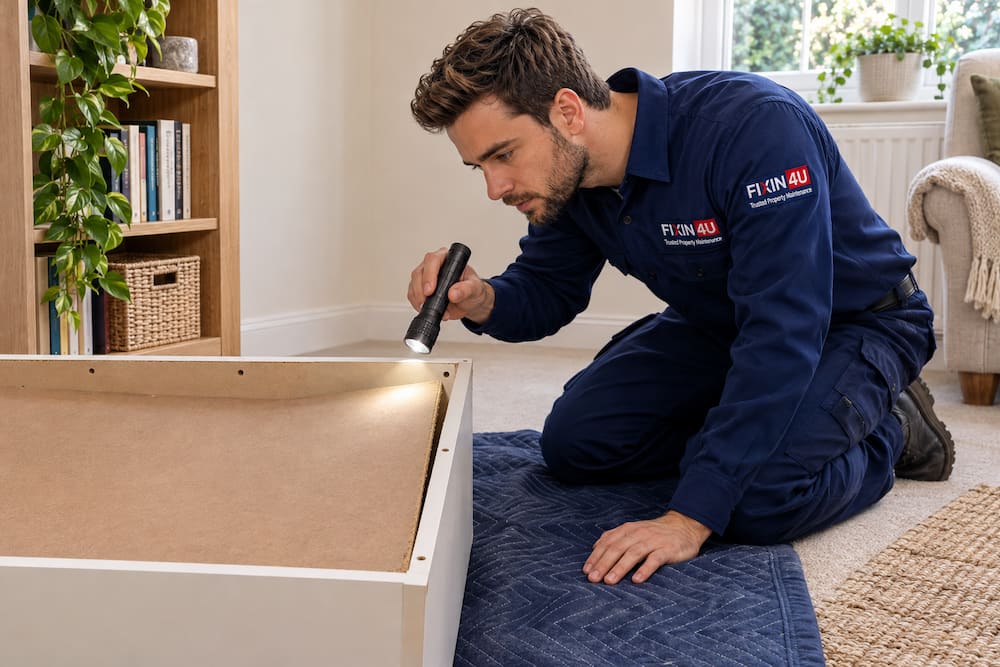 The back-panel arrangement should be checked against the correct
product instructions.
Explain whether any parts were left over, substituted or forced during
assembly. Keep the instructions and unused fittings available. Avoid
adding screws, drilling new holes or repeatedly tightening cam fittings
in an attempt to straighten the furniture; damage may make replacement
parts necessary.
Distinguish hinge adjustment from damage
If the body is correctly assembled and supported, the doors may need
model-specific hinge adjustment. IKEA's BILLY buying guide, for
example, describes horizontal and vertical adjustment for OXBERG
hinges. That is a product example, not a universal screw-turning
sequence for other cabinets.
A door that sits low can also have a loose mounting plate, incorrect
mounting position, incompatible hinge or damaged panel. Look only
at accessible areas where this can be done safely. Do not loosen
a door's fixings without suitable support, particularly with heavy
or glass doors.
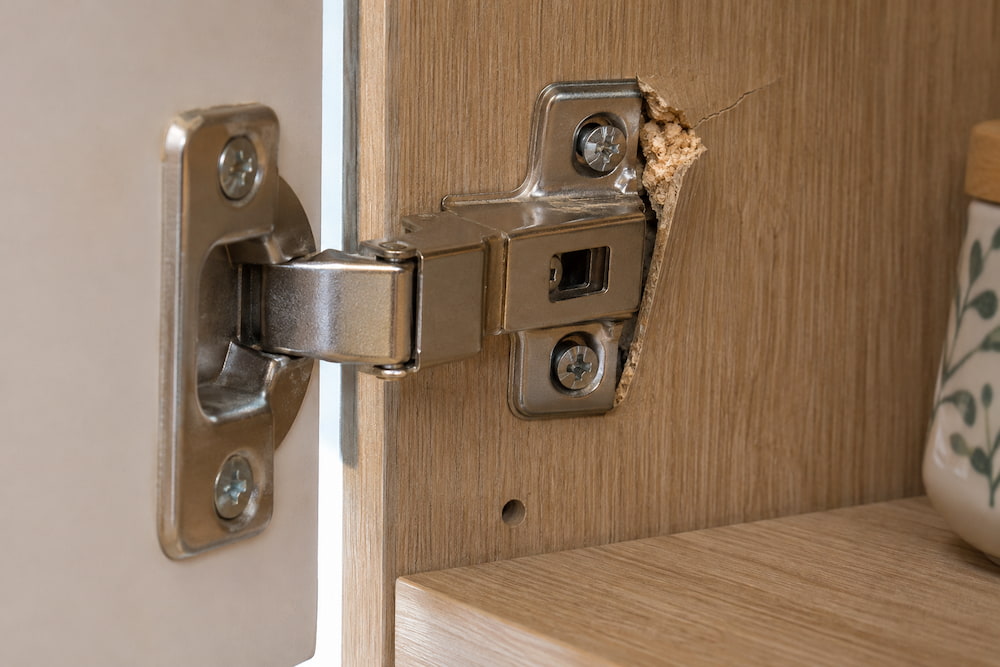 A damaged fixing point needs a different response from ordinary
hinge adjustment.
Crushed board, expanding cracks or a screw that no longer holds are
reasons to stop adjustment. More force does not restore the missing
material. Photograph accessible damage and contact the supplier or
an appropriate repair professional about assessment and replacement options.
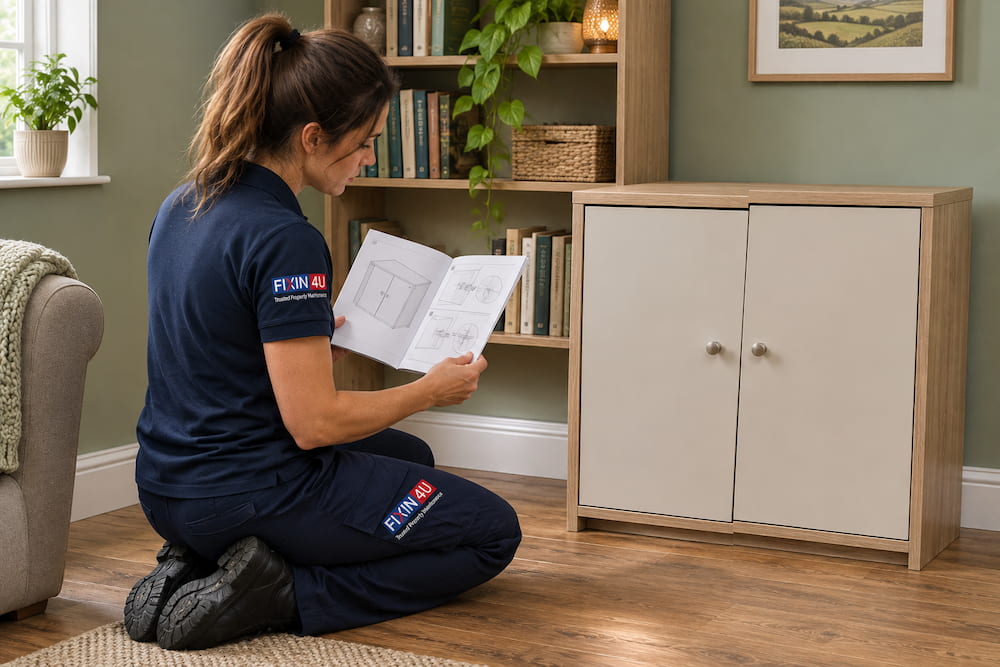 Check the exact model before choosing an adjustment or repair.
Resolve construction issues and complete required anchoring
Correct assembly, suitable floor support and anti-tip restraint serve
different purposes. Follow the manufacturer's anchoring requirements
even if the furniture looks straight. IKEA's BILLY guidance requires
wall attachment and suitable fixings for the wall material; this
should not be treated as optional decoration.
Do not detach an existing restraint to investigate a lean yourself.
An assessor needs to consider the furniture, its condition, the wall
and the specified fixing arrangement together. In rented accommodation,
arrange any necessary permission with the landlord or property manager
while keeping unsafe furniture out of use.
For help
with bookcase assembly, send the product name, manual, overall
photographs and accessible close-ups. Include when the problem appeared,
the flooring, whether doors or shelves were added later and what
anchoring is already present. Do not move the unit just to obtain
a rear photograph.
“This new bookcase leans and its doors have uneven gaps. Please
assess the floor support, frame, back panel and fittings against
the product instructions, and advise on any damaged parts and
the required wall restraint.”
References & Standards
Use the current instructions for the exact furniture model. The IKEA
example below does not establish a universal adjustment or fixing method.
Send Fixin4u your London postcode, product details and photographs
so the assembly problem and appropriate next steps can be reviewed.
Discuss your bookcase problem