Coordinate AHU work in an occupied building by confirming which areas
are affected, naming the people who can approve access and shutdowns,
and agreeing a workable service window. Competent personnel should
plan isolation and the work itself. Before attendance, establish how
occupants will be informed, what happens if the programme changes and
who will accept the return-to-service handover.
For facilities managers arranging
AHU services,
the appointment is only one part of the plan. The work team, building
management and affected occupiers need the same understanding of the
task and its operational impact. This guide covers coordination,
rather than fault diagnosis or technical isolation instructions.
Name the people who can make each decision
Identify one site contact who can coordinate the booking with
building management, the contractor and affected teams. Record who
can approve a shutdown, arrange entry, authorise a scope change and
receive the completed-work report. These may be different people;
a keyholder should not be assumed to hold every approval.
For a multi-tenant property, identify the relevant occupier contacts
and any managing agent involved. Check whether reception, security
or another contractor needs to support attendance. Keep the contact
list current and ensure the agreed decision-makers are reachable
during the work window.
Swipe horizontally to read all columns.
Decisions to settle before the visit
| Decision |
Agree beforehand |
Record clearly |
| Building impact |
Which areas and activities depend on the affected AHU?
|
Confirmed areas, uncertainties and operational restrictions.
|
| Attendance |
Who arranges entry, induction and access to the work area?
|
Site contact, route and arrival arrangements. |
| Shutdown |
Who approves the window and plans the technical precautions?
|
Approval, dependencies and competent personnel responsible.
|
| Changes |
Who decides if the plan needs revising? |
Escalation contact and occupant update arrangements.
|
| Handover |
Who receives the checks and confirms the operational handback?
|
Required records, restrictions and outstanding actions.
|
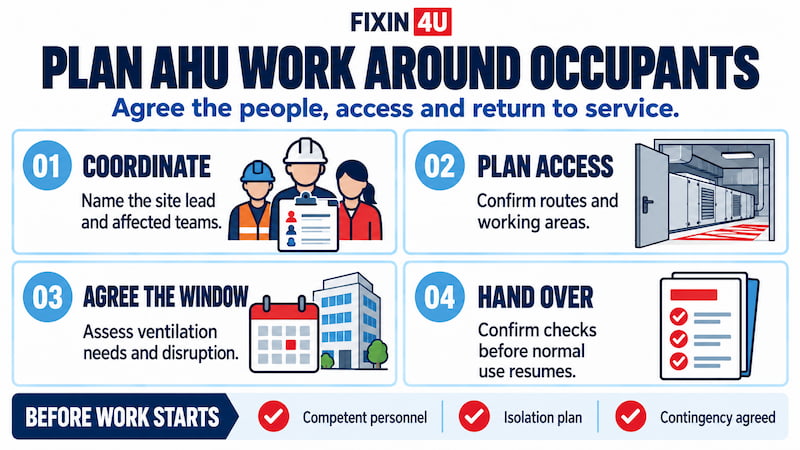 Align the people, site arrangements and handover before committing
to the work window.
Choose the window around the building's needs
Confirm which spaces the AHU serves using reliable site information
and appropriate technical input. Do not assume it serves only the
room nearest the plant. Discuss occupancy, working hours and
activities that could be affected by an interruption before
selecting a date.
HSE's
workplace ventilation guidance
explains the need for adequate fresh air in enclosed workplaces.
Whether affected areas can remain occupied during a shutdown needs
assessment for the building and task. An open window or portable
fan should not be assumed to replace the required ventilation.
Ask the responsible team to assess whether work can be timed
outside occupancy, whether activities need relocating, or whether
another suitable arrangement is necessary. Treat any temporary
ventilation proposal as something to assess and agree, not an
automatic part of the service. Specialised spaces or processes
need their own competent input.
For
AHU Servicing and Planned Maintenance,
distinguish the expected attendance from the period of service
interruption. Allow the programme to account for agreed preparation,
checks and handover rather than assuming the engineer's arrival
and departure define the outage.
Agree access and the boundary of the work area
Confirm the normal authorised route to the unit, including locked
doors, lifts, stairs or roof-access arrangements where relevant.
Plan deliveries and removal of materials with the site team so
they do not conflict with busy reception periods or other scheduled
work. Agree any storage location instead of leaving it to be found
on arrival.
Discuss how the work area will be separated from staff and visitors,
including any noise, dust or odour expected from the agreed task.
Keep shared routes and emergency access available under the site's
arrangements. A familiar plant room still needs its actual
conditions checked by the work team.
Confirm the site's applicable induction, risk-assessment and permit
arrangements with those responsible. This coordination checklist
does not determine which permits are required or provide a method
for working inside the unit.
Tell occupants what to expect and plan for changes
Issue an agreed notice to affected teams stating the date, expected
window, areas involved and practical restrictions. Give a contact
for questions and explain how changes will be communicated.
Describe confirmed arrangements without promising uninterrupted
service or a completion time that has not been agreed.
Before work starts, decide what happens if access is unavailable,
a part does not arrive or an unexpected defect changes the task.
Name the person who can review the effect on occupancy and authorise
a revised plan. Agree when an update should be given if the original
handback time becomes doubtful.
For example, if an office area was due to reopen after a planned
shutdown but the unit cannot yet be handed back, the building lead
needs to review the occupancy arrangements and notify the affected
team. The contractor should not be pressed to restart equipment
simply to meet the original diary entry.
Close the visit with a defined return-to-service handover
Agree beforehand what the work team will report and who will receive
it. The handover should identify completed work, relevant checks,
restrictions and outstanding actions. Keep technical clearance to
reinstate equipment separate from the building team's decision to
resume affected activities.
Ask which functional checks, measurements or commissioning tasks
are included for this job. Do not assume that a running fan proves
the required conditions have been restored throughout the building.
If further verification is needed, establish who will perform it
and how that affects the handback.
Update the site record with the actual interruption and handover
details, circulate any ongoing restrictions and confirm the owner
of each follow-up action. Tell affected occupants when normal
arrangements can resume based on the agreed handover, rather than
on an assumed finish time.
References & Standards
Official guidance supporting the ventilation and safe-maintenance
considerations. This article is a coordination guide, not a
site-specific risk assessment or isolation procedure.
For a Fixin4u AHU enquiry in London, explain the intended work,
building occupancy and access constraints. Share the proposed
shutdown window and site contacts so suitability and coordination
requirements can be discussed before attendance is agreed.
Discuss your AHU visit