Compare AHU service proposals against the same asset list, component
tasks, access arrangements and shutdown assumptions. Then check the
price basis, exclusions and records each provider will deliver.
A lower headline figure is not a like-for-like comparison if one
offer covers inspection only while another includes parts, additional
attendance or defined performance measurements.
For facilities managers reviewing
AHU services,
the aim is to establish what each proposal commits to doing. This
guide focuses on comparing written offers once the intended work is
broadly understood. It does not diagnose faults or decide whether
a particular unit needs maintenance, repair or refurbishment.
Put every offer against one comparison checklist
Use the same brief and asset schedule for each provider. Record
an item as included, excluded or awaiting clarification; silence
is not confirmation. If an offer uses a different unit count,
visit frequency or task list, ask for a comparable version before
judging the price difference.
Swipe horizontally to read all columns.
Questions to resolve in each AHU proposal
| Compare |
Ask each provider |
Record in writing |
| Assets and components |
Which units, sections and tasks are covered? |
Asset references, quantities and task descriptions. |
| Parts and materials |
Are consumables and replacements included or conditional?
|
Specifications, quantities, allowances and exclusions. |
| Access |
Who arranges site access, permits and any specialist
access equipment?
|
Responsibilities and assumptions needing confirmation. |
| Downtime |
What shutdown window, attendance and restart arrangements
are assumed?
|
Agreed timing, dependencies and additional-visit conditions.
|
| Deliverables |
Which reports, readings and completion checks will be supplied?
|
Defined outputs and their scope. |
| Price and changes |
What is the total for the agreed work, and how are
changes approved?
|
VAT basis, exclusions, validity and variation procedure. |
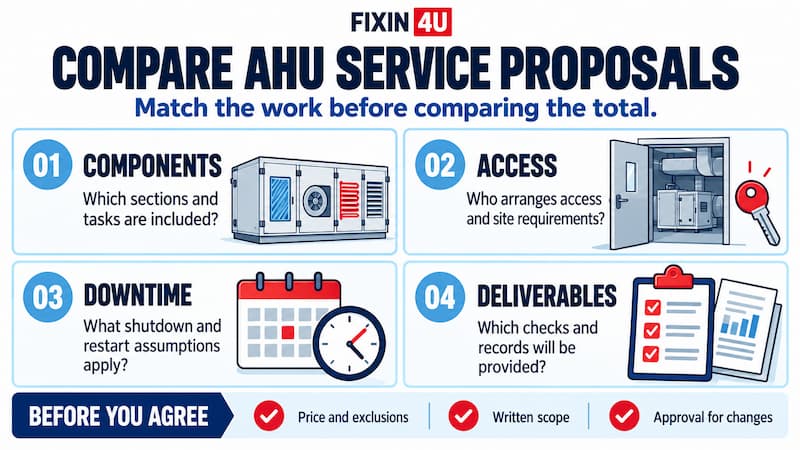 Use one checklist for every proposal and resolve unspecified items
before comparing the totals.
Check the action promised for each component
A list of components is not a list of tasks. “Filters included”
could refer to inspection, cleaning where appropriate, supply of
replacements or fitting replacements supplied by the client.
Ask for the action and quantity to be stated. Apply the same
distinction to fans, belts where fitted, coils and other relevant
sections.
For a planned service, distinguish routine checks from investigation
of a known fault. An offer to inspect an accessible component does
not automatically cover dismantling, repairs or replacement. The
detailed servicing requirements should sit within the agreed
AHU Servicing and Planned Maintenance
scope.
For example, one proposal may include checking the filter section
but exclude replacement filters; another may include specified
replacements and fitting. These illustrative offers are not
equivalent. Ask both providers to price the requested task on the
same basis, with any unresolved specification clearly marked.
Where a component change is proposed, check what compatibility
assessment is included and what remains to be established. A broad
phrase such as “controls included” should not be read as a promise
of building management system programming or integration.
Compare access and downtime on the same assumptions
Read the access qualifications alongside the price. One offer may
assume a clear plant-room route and normal working hours, while
another allows for restricted access or attendance outside those
hours. Establish who arranges escorts, induction, permits and any
required access equipment, and which costs are included.
Ask whether the stated duration means time on site, active working
time or the period the AHU will be unavailable. These are different
quantities. Confirm whether the proposal assumes one continuous
shutdown or several shorter windows, and how the building's
operating needs affect the plan.
Identify dependencies such as approved shutdowns, parts availability
and attendance by another contractor. Ask what happens if access is
unavailable or the agreed window changes, including how waiting
time or a return visit would be handled. Do not treat a provisional
programme as confirmed availability.
Define the records and checks you will receive
“Service report included” leaves room for different outputs.
Ask whether the report identifies the assets attended, tasks
completed, parts changed, areas not accessed and outstanding
recommendations. Where readings are part of the work, agree which
readings and the context needed to interpret them.
Distinguish a visual inspection or functional check from measured
airflow work. If you require
airflow balancing and recommissioning,
confirm the measurement locations, available design information,
intended adjustments and records within that specific scope.
A general service report should not be assumed to contain a
whole-system performance assessment.
Ask how completion will be demonstrated against the agreed tasks.
A photograph of a replaced component can document a change, but
does not on its own demonstrate airflow, energy use or performance
across the building. If the proposal includes a performance
objective, identify the agreed verification method and any limitations.
Check the price basis, exclusions and change approval
Confirm whether the offer is a fixed price for a stated scope,
an estimate subject to survey, a time-based charge or a recurring
arrangement. For recurring work, compare the same period, visit
count and tasks per visit. Do not compare an annual programme
with a single attendance figure.
Record whether VAT is included or additional, and check the
treatment of parts, consumables, travel, access equipment, disposal,
specialist attendance and further visits where relevant. These
are items to clarify, not a claim that every job incurs each
charge. Ask for the total and any conditional allowances to be
shown separately.
Agree who can authorise a change and how the extra scope and price
will be recorded before the work proceeds. If an assessment
identifies an additional defect, distinguish the findings from
approval to repair it. Keep the proposal revision and subsequent
written agreements together.
Check validity dates, payment stages and any stated warranty or
follow-up terms in the actual offer. Do not assume that a general
promise of “support” defines what is covered, for how long or at
what cost.
Resolve gaps before choosing between totals
Send each provider the unresolved questions and request a revised
written scope where necessary. Once the proposals cover comparable
work, assess the price alongside the access plan, deliverables and
remaining uncertainties. A larger package is useful only if its
additional tasks meet your requirements.
If an offer claims energy savings, ask for the baseline, operating
assumptions, proposed intervention and method of checking the
result. An unsupported percentage is not a sound basis for
comparing value. Keep any projected benefit separate from the
confirmed price and deliverables.
References & Standards
The source below supports the maintenance-planning precautions.
The proposal checklist is a practical comparison aid, not a
prescribed contract or certification standard.
For a Fixin4u AHU enquiry in London, share the assets, requested
tasks and site constraints. Ask for the proposed inclusions,
exclusions, price basis and handover records so you can assess
the work being offered.
Discuss your AHU requirements