To help scope AHU work, gather the unit's asset ID, make and model,
location, available drawings, service history and access constraints.
Add a short description of the work you need and identify any
information that is missing or uncertain. Existing records help define
an assessment; they do not replace checking the actual unit and site
conditions.
For facilities managers and building operators arranging
AHU services,
a small, organised information pack is more useful than an unlabelled
folder of documents. The aim is to connect the request to the correct
air handling unit and show what is already known, what has changed
and what still needs assessment.
Build a short asset information pack
Start with records your team already holds. Do not delay an initial
enquiry simply because the pack is incomplete: state what you have
and list the gaps. If several units are involved, give each a
separate summary so a fault report or drawing cannot easily be
assigned to the wrong asset.
Swipe horizontally to read all columns.
Information that helps define an AHU assessment
| Information |
Useful details |
Flag if uncertain |
| Identification |
Site asset ID, manufacturer, model, serial number and location.
|
Missing label, conflicting IDs or approximate age. |
| Drawings and manuals |
Relevant layouts, schematics, equipment schedules and
model instructions.
|
Old revisions, generic manuals or undocumented changes.
|
| Maintenance history |
Recent service reports, outstanding actions and known
component changes.
|
Recommended work without evidence of completion.
|
| Current concern |
What is happening, when it started and which unit or area
is affected.
|
Suspected causes that have not been investigated.
|
| Access and operation |
Unit position, access route, site procedures and possible
shutdown windows.
|
Unconfirmed access, permissions or operational restrictions.
|
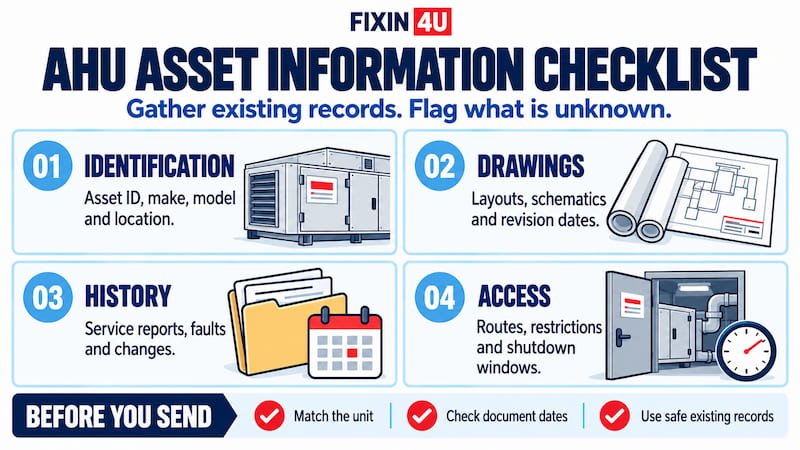 Gather the records already available and clearly identify missing
or unverified details.
Identify the unit before describing the task
Give the site name or postcode, the unit's asset reference and its
physical location. “AHU-02, west plant room” is more useful than
“the ventilation unit upstairs”. Include the areas it serves where
this is established by site records; do not guess from its position
in the building.
Add the manufacturer, model and serial number from existing records
or a safely visible label. Mark the installation date or age as
approximate if it is only an estimate. If a building management
system uses a different unit name, record both names and explain
the known relationship rather than silently treating them as
interchangeable.
A dated overall photograph can help distinguish similar units.
Only use photographs taken from an authorised, safe position.
If identification requires opening a panel, reaching into plant
or accessing an unfamiliar roof area, leave that task for the
appropriate site personnel.
Label drawings and manuals with their status
Send the documents relevant to the unit and the requested work.
These may include a plant layout, ventilation schematic, equipment
schedule, manufacturer's instructions and available commissioning
records. Explain what each file shows rather than assuming the
recipient knows your site's filing system.
Keep the drawing number, revision and date visible. Say whether a
drawing is a design issue, an as-built record or simply the latest
copy you could find. Even an as-built drawing may need checking
against later alterations. Do not present an old drawing as verified
current installation information.
If the manual covers several models, identify the relevant model
where known. Record any known replacement fan, motor, coil or
control change because original documentation may no longer describe
every installed part. Existing airflow or operating readings should
retain their date, units and measurement context; a design value
and a measured result are different kinds of evidence.
Separate service history from the current fault report
Provide recent maintenance reports and any older report that
explains a recurring issue or significant modification. A short
timeline can identify the last service, a reported defect, the
work authorised and the outcome recorded afterwards. Keep the
original reports alongside the summary so important qualifications
remain available.
Distinguish “replacement recommended” from “replacement completed”.
If a previous report identified a defect but you cannot find a
completion record, list the action as unresolved. Similarly, a
recent service date does not show which components were checked
unless the report describes them.
For an active problem, record the symptom, when it occurs and any
relevant existing alarm history. If you are arranging
AHU Repairs and Fault Finding,
include previous investigation findings. Do not turn “unit stops
intermittently” into a confirmed motor fault without diagnostic
evidence, and do not change settings or repeatedly restart
equipment to create a demonstration.
Describe access and operational constraints
Explain whether the unit is in a plant room, on a roof or in another
restricted area. Describe the normal authorised route, stairs or
lifts, locked doors and any known space restrictions around the
casing. Existing route photographs can help, but they do not
establish that equipment or replacement components can be moved
through it safely.
Identify the site contact, induction requirements and applicable
permit arrangements. State the building's operating hours and the
shutdown windows that may be available. Distinguish a suggested
window from one already approved by the responsible person,
especially where stopping the unit affects occupied areas.
Send a clear summary with the supporting files
Keep the covering note brief: identify the asset, state the
requested outcome and list the attached records. Use recognisable
file names containing the asset reference, document type and date.
Send relevant records through the agreed channel, excluding
unrelated personal information, access codes and login credentials.
“Please scope an assessment of AHU-02 in the west plant room.
The unit has intermittent shutdowns; the cause is not confirmed.
Attached are the latest service report, existing alarm records
and the ventilation drawing, revision C. A fan change is recorded,
but updated drawings have not been found. Access requires site
induction. A weekend shutdown may be possible, subject to approval.”
This is an illustrative enquiry, not a diagnosis. Finish by
identifying missing information and asking what further assessment
is needed. A well-organised pack can make the initial discussion
more specific, but it does not guarantee a fixed price, confirm
hidden condition or remove the need for a site survey.
References & Standards
The source below supports the maintenance-planning and access
precautions. The document checklist is a practical briefing aid,
not a prescribed statutory form.
For a Fixin4u AHU enquiry in London, share the unit identification,
relevant records and access constraints. Explain the outcome you
need and what remains unknown so the appropriate assessment and
scope can be discussed.
Discuss your AHU requirements