AHU maintenance is planned care for an existing unit; repair investigates
and addresses a particular fault; refurbishment renews selected parts or
sections through a defined project. Choose the starting route by the
purpose of the work and the evidence available. An overdue service,
an unexplained shutdown and a proposed upgrade need different briefs,
even when they concern the same air handling unit.
For facilities managers and building operators, the useful question is
what the next visit needs to establish. This guide explains the scope
boundaries within
AHU services.
It does not diagnose individual components or decide whether a
particular unit is suitable for refurbishment.
Compare the purpose before the service label
An air handling unit forms part of a building's ventilation system.
Its configuration determines which components and tasks are relevant.
HSE explains that mechanical ventilation uses fans to move air into
and out of rooms; the particular unit and the wider system still
need to be understood before work is specified. See
HSE's workplace ventilation overview.
Here, maintenance means planned upkeep; in broader engineering usage
it can also include corrective work. The three scopes below describe
different reasons for a visit. They are not fixed packages or a
compulsory sequence. A maintenance visit may reveal a defect, while
a repair investigation may identify a wider condition issue needing
separate assessment.
Swipe horizontally to read all columns.
What each AHU scope is intended to address
| Route |
Main purpose |
What to define |
Do not assume |
| Maintenance |
Planned upkeep and observation of condition. |
Tasks, accessible components, service items and records.
|
Every fault investigation or replacement part is included.
|
| Repair |
Investigate a fault and agree corrective work. |
Reported symptoms, diagnostic scope, findings and repair approval.
|
A symptom identifies the failed component or guarantees
a one-visit fix.
|
| Refurbishment |
Renew selected parts of an existing asset through a planned project.
|
Survey findings, retained sections, proposed changes and verification.
|
The whole unit becomes new or a particular saving is guaranteed.
|
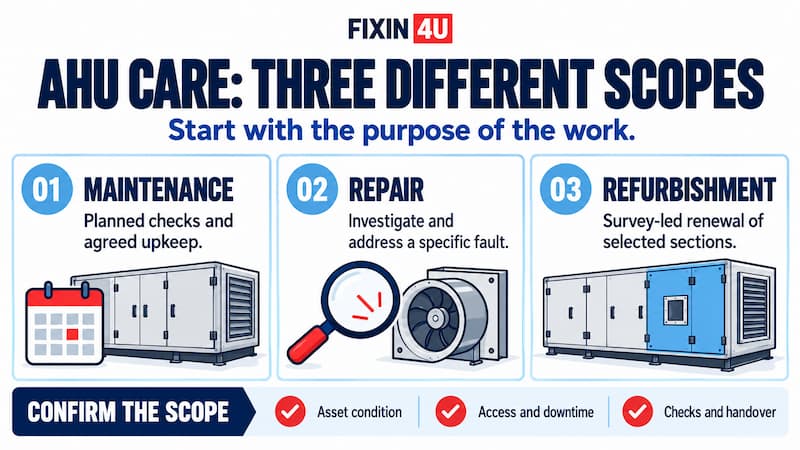 Start with the purpose of the work, then agree the tasks and evidence
needed for that asset.
Maintenance: planned care and a usable condition record
Maintenance addresses the unit's ongoing care. A useful brief identifies
the asset, available history and tasks to be considered, rather than
relying on the word “service” alone. Planned preventive maintenance is
often shortened to PPM; the abbreviation does not define the contents
of a particular visit.
For example, the agreed work may concern accessible filters, belts
where fitted and general condition observations. Confirm whether
consumables, replacement parts or follow-up work are included. A
report should distinguish completed tasks from areas not accessed
and recommendations still awaiting action.
A service schedule should reflect the equipment and its operating
conditions. HSE's
work-equipment maintenance guidance
advises using the manufacturer's maintenance instructions when
planning the work. A generic interval in a blog cannot establish
the right schedule for your AHU.
Use
AHU Servicing and Planned Maintenance
for the detailed servicing scope. If the unit has an active fault,
disclose that separately so a routine visit is not expected to
resolve an unscoped breakdown.
Repair: establish the cause before specifying the remedy
Repair starts with a defined problem, such as a unit that will not
start or repeatedly stops. Describe what happens and when, using
existing alarms, operating records and reports where available.
A symptom is evidence for an investigation; it is not proof that
a fan, motor, sensor or other particular component needs replacement.
Separate the diagnostic visit from the corrective work it may
recommend. Ask what the investigation covers, what findings will
be recorded and how any additional parts or work will be authorised.
Restoring operation after a targeted repair does not mean the whole
unit has been refurbished or that unrelated service items have
been completed.
For an unexplained operating fault, the next step is
AHU Repairs and Fault Finding.
Detailed component diagnosis belongs in that assessment, rather than
in a broad comparison of service labels.
Refurbishment: define what will be retained and renewed
Refurbishment concerns a planned intervention in an existing asset.
The scope might address selected worn sections or a proposed
component upgrade; it should identify the parts being retained as
clearly as those being changed. It is not simply another name
for a larger repair bill.
Start with a survey brief stating the intended outcome and the
known condition concerns. A feasibility review needs to establish
whether the proposed changes suit the retained unit and its
connections to the building. Age alone does not settle that
question, and an upgrade proposal should explain how its claimed
benefit will be assessed.
The detailed maintenance-versus-refurbishment and
repair-versus-refurbishment assessment belongs with
AHU Refurbishment and Upgrades.
Confirm the technical scope, compatibility and required checks
there. Do not read a refurbishment enquiry as confirmation that
a complete replacement AHU will be supplied or installed.
Turn the chosen route into a clear brief
Begin with one sentence describing the outcome you need.
“Review the scheduled upkeep of this unit” is different from
“investigate its recurring shutdown” or “assess renewal of these
deteriorated sections”. These are illustrative briefs, not
diagnoses or promises about what a visit will find.
-
Asset:
identify the unit and the areas it serves using available records.
-
Evidence:
provide relevant service reports, fault history or condition findings.
-
Constraints:
explain access, site procedures and permitted shutdown windows.
-
Scope:
list the agreed tasks, exclusions and work requiring further approval.
-
Handover:
agree the records and checks needed before return to service.
If maintenance and a fault investigation are both required, state
both objectives and ask how they will be scoped. They may need
different arrangements. Similarly, a repair can address an immediate
issue while a separate refurbishment proposal is assessed; neither
task automatically includes the other.
Agree how completion will be demonstrated
Match the handover to the task. For maintenance, ask for completed
checks and outstanding actions. For repair, ask for the findings,
corrective work and checks relevant to the fault. For refurbishment,
ask for the agreed record of changed and retained sections and the
verification specified for the project.
Distinguish a functional check from a wider performance assessment.
If airflow measurements, balancing or recommissioning are required,
have those tasks expressly defined. A running fan alone does not
establish that every room receives the intended airflow, and no
service label guarantees energy savings or a particular remaining
asset life.
References & Standards
Official guidance supporting the ventilation context and
maintenance-planning precautions. These sources do not define
a universal AHU service package.
For a Fixin4u AHU enquiry in London, share the unit details, the
reason for the work and the site constraints. The appropriate
maintenance, fault-finding or refurbishment scope can then be
discussed, with suitability and technical requirements confirmed
before work is agreed.
Discuss your AHU requirements